This is an exerpt from my book “Stompin’ Grouds” that I am finishing up, and hopefully will get published. Since I am trying to publish it, this is the last exerpt you will see for a while.
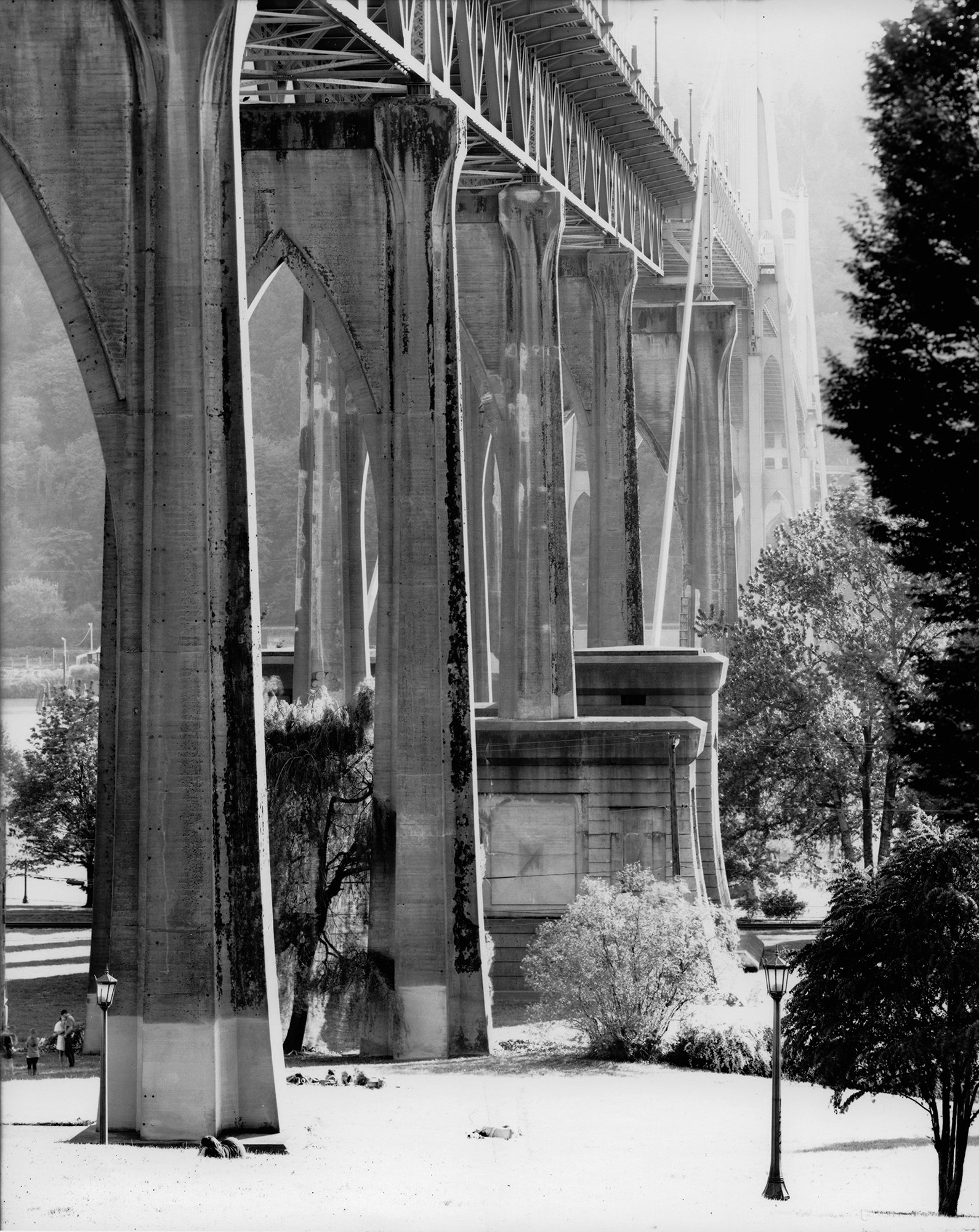
St Johns Bridge, October 2009
In 2007, I bought my first 4x5 camera. I also built a darkroom in the basement of the house I bought with my second wife in 2003. I was determined to finally follow in Ansel Adams’ footsteps.
Adams was meticulous in his process, and developed a process of film testing, developing, and printing black and white known as the “Zone System. However, I am, above all else, one who likes to try everything (as long as it won’t kill me or make people laugh and point). My entry into large format film came as the industry started to shrink. By then, digital was driving film camera companies, and film manufacturers out of the market. The upside was that film equipment became cheaper. I wanted to try every black and white film possible, and every developer before the companies wentbankrupt. I bought films by Ilford, Efke, Foma, Kodak, Fuji, Bergger, Adox, Agfa, and Rollei, and developers like: Kodak Xtol, D76, and HC-110, Photographers’ Formulary BW44, PMK Pyro, and Pyrocat MD, and other developers by Clayton Chemicals, Agfa, and Fotospeed. Soon, I started mixing my own from raw chemicals, and in my quest to become more environmentally friendly, I experimented with developers made from coffee and vitamin C.
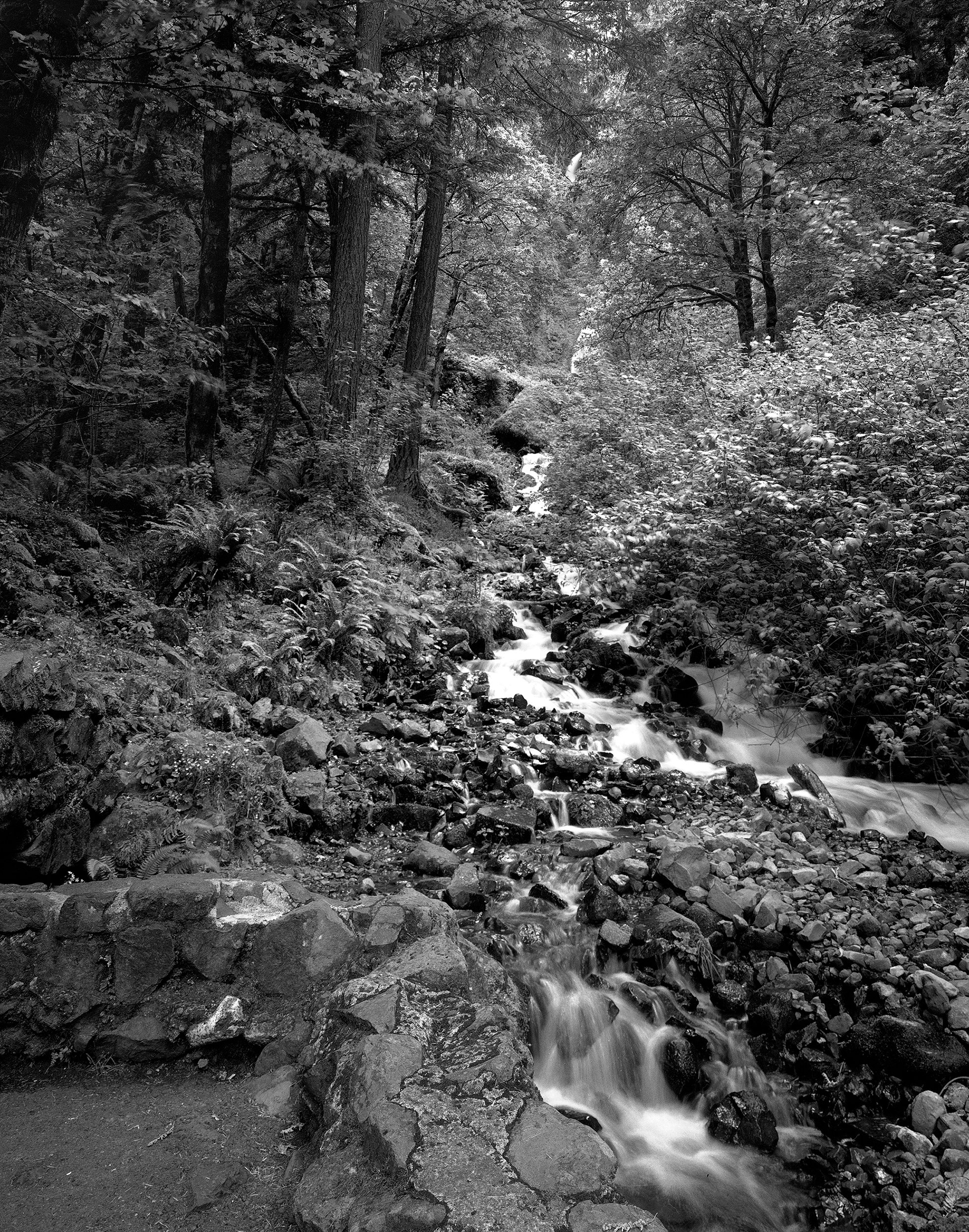
Wahkeena Falls in the Columbia Gorge, 2014. Developed in Coffee.
My processes were all over the map. Ansel Adams’ footprints were elusive. As time moved on, and the error of this way presented itself in numerous unusable negatives, I began to settle down. I’m down to just a few films, and a few developers, and bought a densitometer to start film testing.
For those interested, I included the technical details for each picture in the notes at the end of this book, such as: camera, film, lens, and developer (Those items will be in the book if you are interested).
Notes on some of the following pictures: The Hasselblad 500CM is a square format camera that makes 6x6 centimeter negatives (or slides). The square format gives the photographer the option to crop to either landscape or portrait format without turning the camera on its side. I never think about it that way. I compose for square pictures when I use it.
My early explorations of the Portland area concentrated on the Eastside Waterfront, with the city skyline as a backdrop, and some intensely beautiful bridges as the main subjects. The bridge I was initially drawn to the most was the Hawthorne Bridge.
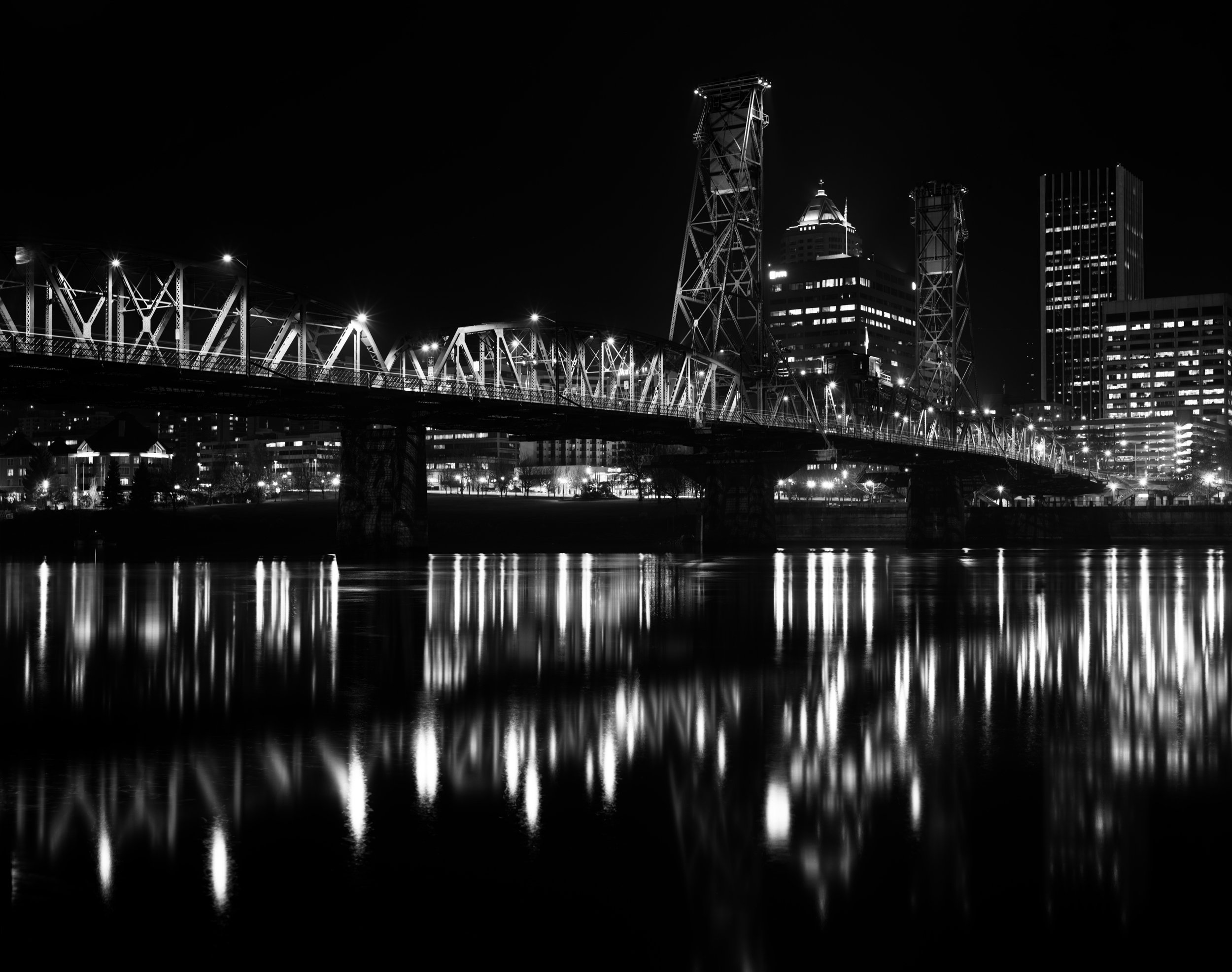
Hawthorne Bridge at Night, 2009
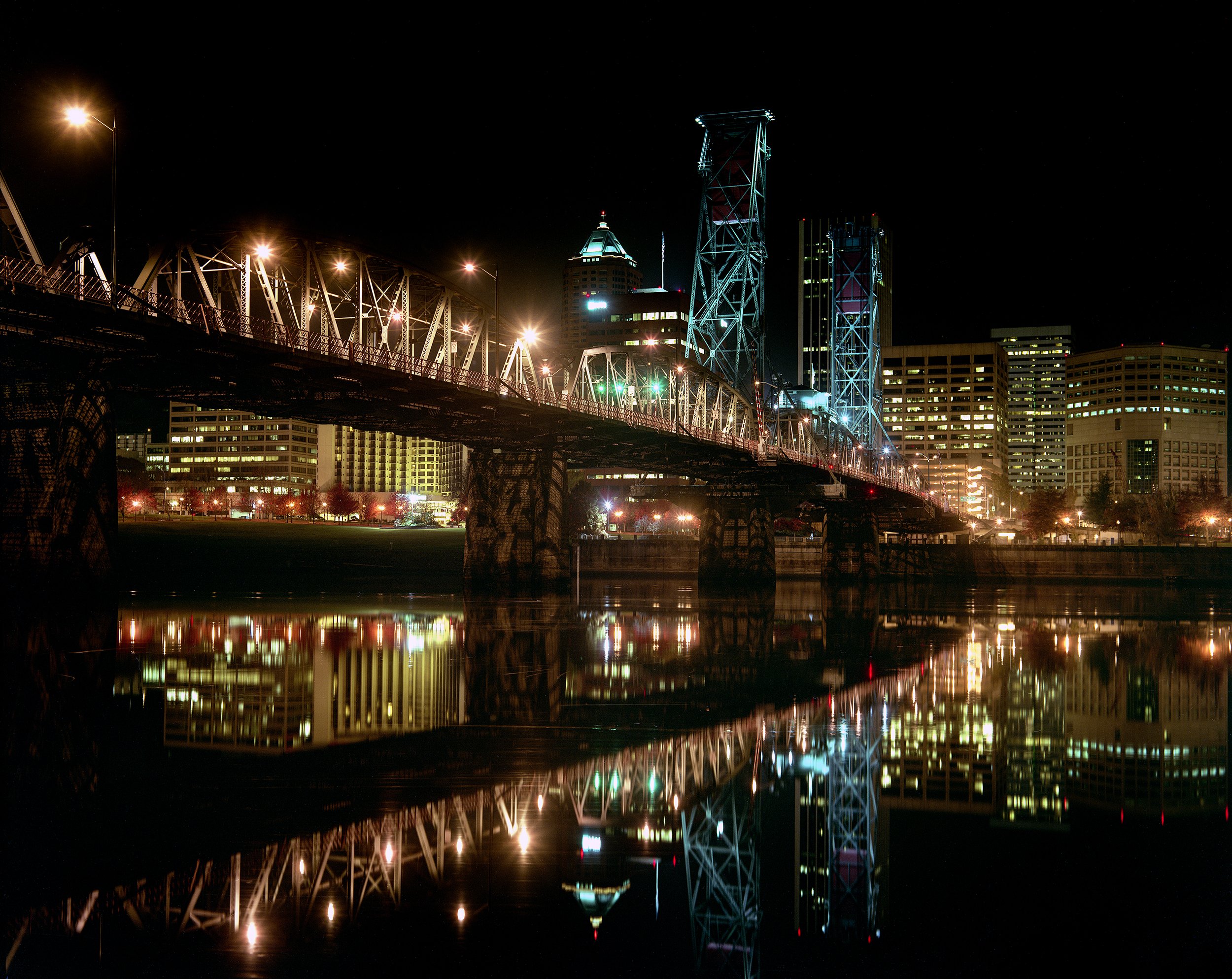
Hawthorne Bridge at Night, 2008
After the Hawthorne came the Saint Johns Bridge. The fortunate thing about that bridge, for me, was that I was better with the big cameras by the time I began exploring it.

St Johns Bridge, October 2009
The Saint Johns Bridge spans the Willamette River in North Portland. It was built in the 1930’s seemingly, at the time, from nowhere to nowhere. The neighborhood of Saint Johns was a going concern by then, but Yeon Ave., where the bridge empties on to, runs along therailroad tracks on the river’s western bank where it makes a turn northward toward the Columbia River, was a bit of a backwater at the time, except for the west side industrial district west of the bridge.
The Saint Johns Bridge is an engineering masterpiece. The graceful curves of the suspension cables to the cathedral-like main supports make it a stunningly beautiful bridge.
Portland has a unique vibe that has inspired young people to flock to it, but has also elicited criticism, and more than a little scorn from certain political persuasions. For me, Portland is the beating heart of Oregon, as well as its economic engine. Oregon’s fortunes rise and fall with Portland. My photographic explorations of it concentrate on the historic, and the awe-inspiring.
I do not claim any superpowers. The focusing hood I use with my large format cameras does not have a big, red ‘S’ on it. Anyone driven to do something properly will eventually get better at it. Yet, my dogged pursuit of the large negative while the film world was imploding in the wake of the digital revolution does give me some street cred among today’s trendy film shooters. Even when I finally bought a digital camera, I still trotted the film cameras out consistently. Occasionally, I trotted out a lot of them.
My explorations after 2007 sometimes involved a car packed to the gills with camera gear. I drove across the country in 2014 with seven cameras with their associated gear. The gear for an 8x10 camera takes up a lot of space. There were times when I did not use the camera I wanted to because digging it out was too daunting. I have learned to moderate over the years, but sometimes I still get carried away while packing the car.
Thanks for reading. Please follow my blog if you have the inclination.