This is Who I Am
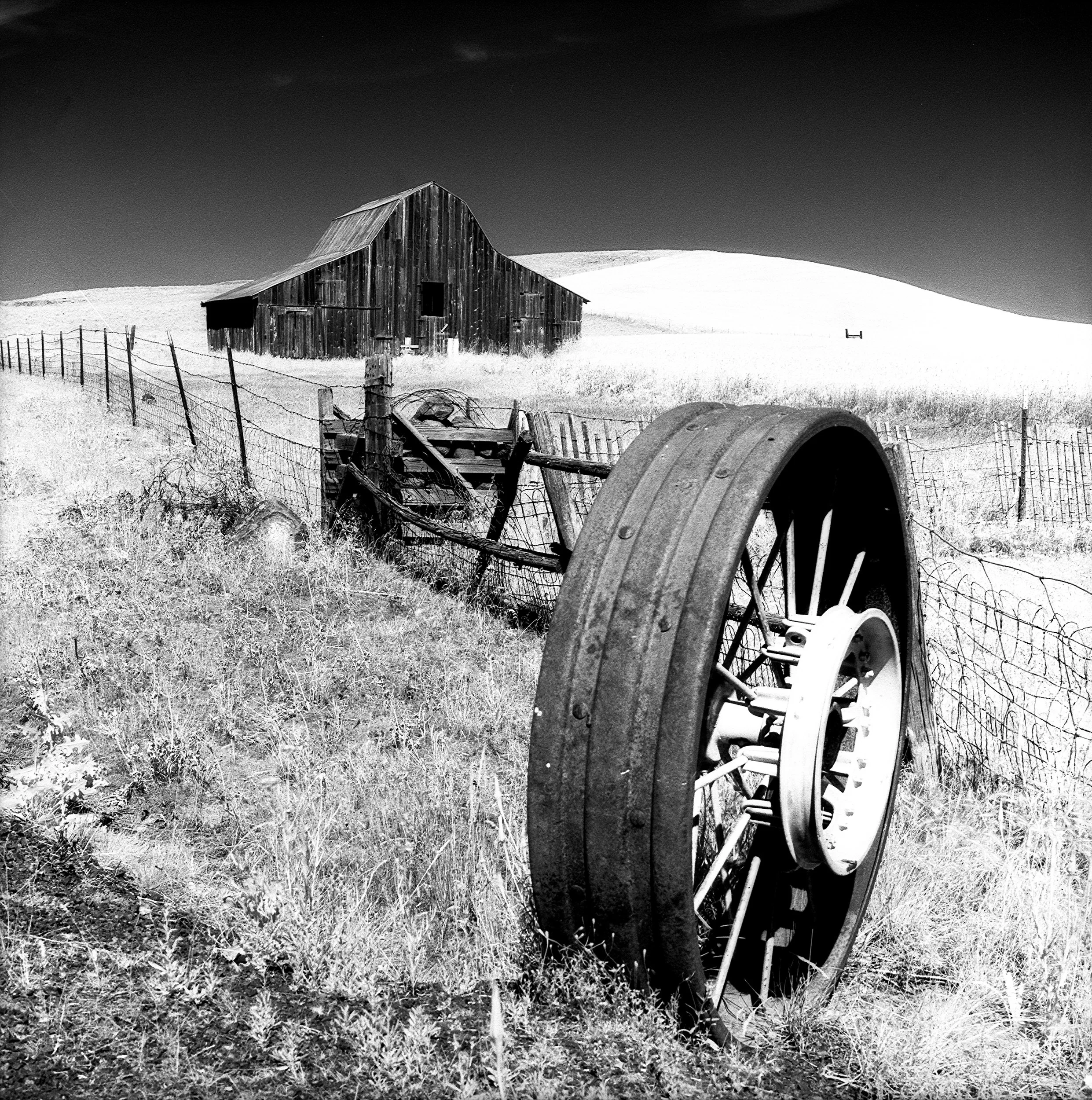
“The Wheel” ©2003 Gary L. Quay
“Go west, young man,” My wife said, “Oh, and take me with you.” It did not exactly work out that way. She had left before me, and traveled west in a U-Haul truck with her father while I finished up my Army commitment at Fort Dix, New Jersey. Then, it was my turn. I left Pennsylvania in a rusting pickup truck that I had named “Entropy” (after Newton’s Second Law of Thermodynamics, which states that everything in the universe tends toward disorganization and decay) with a ration of peanut butter and jelly sandwiches, salted sunflower seed, and cigarettes, heading toward this unfamiliar place called Oregon.
I rolled across Ohio, Iowa, and Illinois while watching the scenery slowly change from familiar to strange. I flew through the Central Lowlands of the Midwest, with its long, straight stretches of highway, followed by Great Planes in Nebraska. On the third night I watched shooting stars in Wyoming, and understood for the first time what “Big Sky” meant. I remember not wanting to go to sleep. The next day I drove into a tiny, but determined downpour that started with a single, menacing thunderhead looming over the road like a hellish ‘V’ in the distance. Eventually, it stormed so hard that I had to pull over, but it lasted for only a lightning-singed minute or so, and then I drove on under a crystal blue sky. I had never seen anything like that before.
Entropy took the miles in stride. The anticipated steady stream of truck parts in the rear-view mirror never materialized. It helped that I had replaced quite a number of those parts in the previous 6 months. I rode her hard every day, and put her away wet every night, sleeping in the cab because I could not afford hotel rooms.
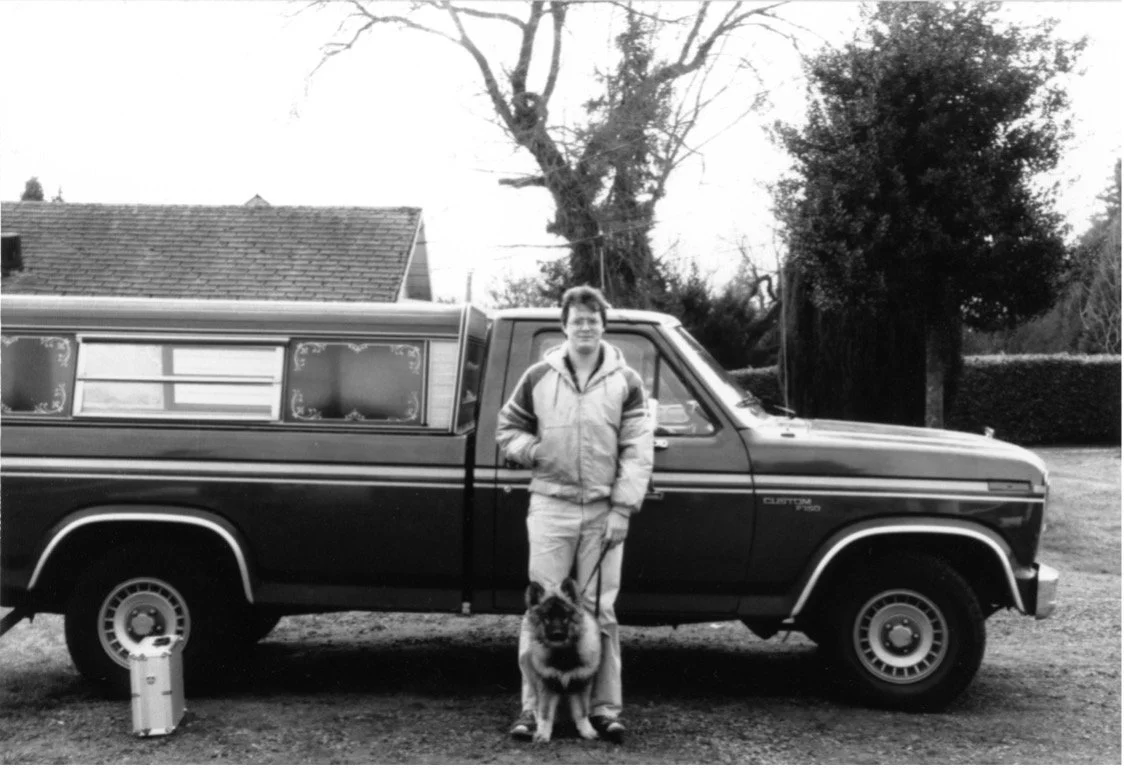
Me, My Dog, and Entropy, Winter 1992
The landscape of the American West, known to me only from old movies and Road Runner cartoons, passed by my windows mile after mile, state after state, leaving me awestruck by the rugged beauty of mountain and plain. Entropy ascended the Rocky Mountains with zeal, floated down into Utah, and strutted past Salt Lake City like a cheap date in an expensive dress, and finally cantered into Oregon’s Blue Mountains on September 21, 1991. Being the end of summer, the flora shifted to golden grasses and tumbleweeds.
Pennsylvania lies in the humid east. The grass grows green there all year, and the billion-year-old mountains, clothed in deciduous forests that strip nekkid every autumn, have eroded into nubs of their former selves. The mountains I knew best were the Appalachians. Having hiked its famous trail on many occasions, wind in the leaves and the smell of the soil were my companions. Needless to say, my concept of terrain was altered by the Rockies, but eastern Oregon, with its semi-arid expanse of white oak, ponderosa pine, treeless hills, and dormant grasses seemed like wandering on an alien planet. I was pleasantly surprised when I hit the Blue Mountains. There, at least, it was green.
I pulled into a rest stop east of Pendleton near noon the next day. A middle-aged couple told me that they saw my PA license plate, and wanted me to know what awaited me a few hours west. Having been past Baker City and into the Blue Mountains, I was skeptical that the scenery could be much more intense. They told me, “If you’re from Pennsylvania, “You’re going to love the Columbia Gorge.” I had never heard of it. We talked about my drive across the country in a 1981 Ford F-150 pickup truck, what brought me to Oregon, and the beauty of Oregon (the little of it I had seen).
I had to get going, so we said goodbye. I resumed my westward trek, knowing that I would make it to my new home in Portland by evening. My wife was there, and we had not seen each other for months.
Shortly after I left the rest stop, I passed a sign that read, “Deadman Pass”. A fine, Western name, I thought. I was atop what locals called “Cabbage Hill”, and was about to be hit in the windshield by a large chunk of Oregon. Imagine if you will, an angel choir singing a long, rising note as the road emerges from the top of a mountain and into open air what seemed like a mile or so above the valley floor, and the heavens opening up for me and my rusty pickup to reveal the scope of creation. Think I am overstating it? I am, but try it sometime. Cabbage Hill is one long, treeless vantage point that unveils the farmlands east of Pendleton, splayed out in a dusty checkerboard in a 180-degree view. That grand sweep of Earth with scant trees, and distant plumes of dust from wheat harvest perched on this East Coast kid’s chamber door of consciousness, and would not leave.
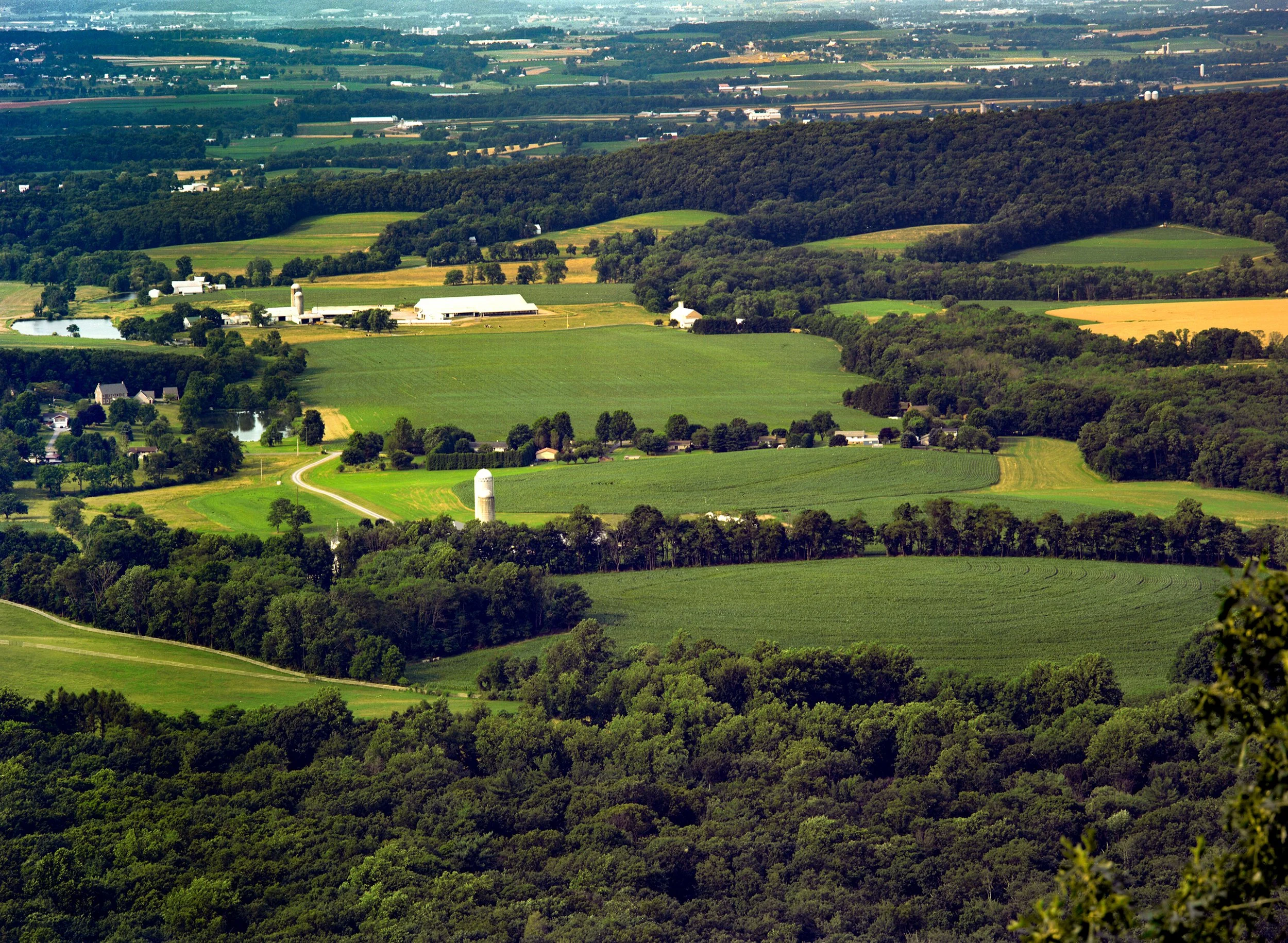
The View From White Rock, Bethel, Pennsylvania (for comparison with Cabbage Hill)
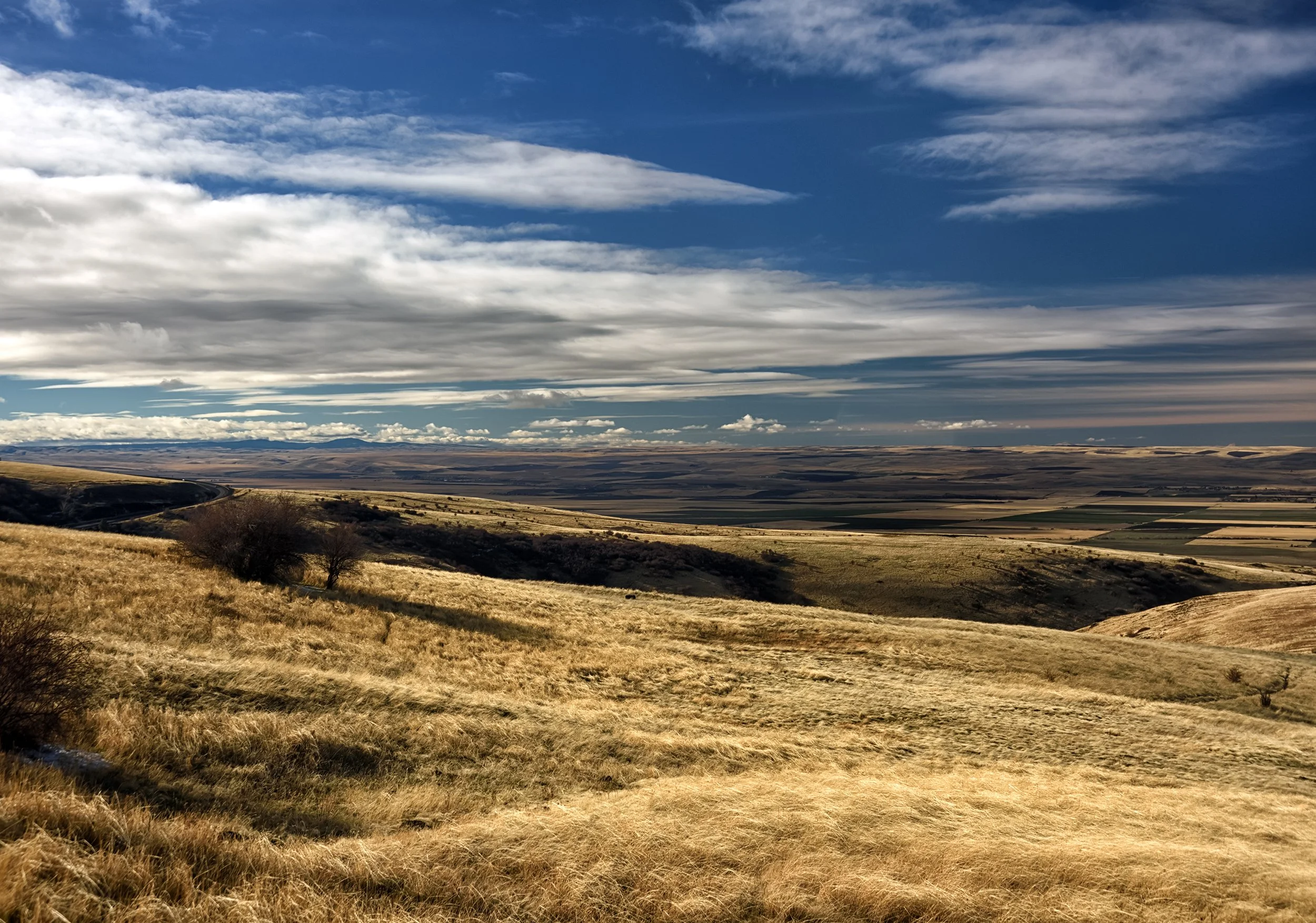
The View from Cabbage Hill, Pendleton, Oregon, March 2013 ©2013 Gary L. Quay
Nonetheless, it took me 22 years to make the trip back. Life happens.
For years, I basked in the familiarity of Western Oregon. As predicted, I did come to love the Columbia Gorge and the wet and wonderful Oregon Coast. When I picked up a camera, I turned the lens to face those places: The green mountains, the waterfalls, oceans, and streams, the forest floors with ferns and moss-covered rocks. I pointed it toward Portland’s bridges and its magnificent skyline. All the while, Cabbage Hill occupied a tiny slice of my brain. It was there, for the first time since I had set out from Pennsylvania, I understood that I was going to be somewhere different, at least for a while.
I never intended to stay in Oregon.
Thirty five years later, I am still here. Life, as I said, happens.
On that September day long ago, darkness had settled in by the time I reached the Columbia Gorge. My camera, a Minolta XG-1, was packed in a box in the back of the truck. Photography had been a passing phase that had mostly ended when I left Germany in 1984. Dark shapes of tall trees and mountain peaks passed my windows as I sped into the night, still ever westward until I-84 ended at the Willamette River on the east bank of Portland. My introduction to the place where I would live for the next 35 years (minus 4 years living in Hood River — more on that later) was the brightly lit city skyline reflected in mirror-like water. I was going to live here? Wow! What a shame that I had to keep my eyes on the road.
My view of cities had been tarnished by PA burgs like Reading, Philadelphia, and the then-sooty Pittsburgh. These eastern cities with their smog-filled skies, oily smells, and rusty cars were not places of beauty back then. That cities could be stunningly beautiful had never occurred to me.
On that September evening, however, I followed the road map to a little apartment building along Barbour Blvd., and made my way to the second floor. When the door opened, we looked at each other for a few moments, and then embraced.
I made regular trips to the Columbia Gorge starting the next spring. Photography grew from a fascination to a passion. At first, I had no clue what I was doing. You will not see any of those pictures here. I used film from the grocery store, and got the pictures developed at drug stores. Since I was the sole wage earner in my household, making ends meet took precedence over buying equipment. I bought what my meager wages would allow: Off-brand lenses and discount film. I struggled with the cheap tripod that I had dragged home from Germany. As you would expect, I became deeply dissatisfied with my work. I started asking questions of anyone who I thought could help.
My first important piece of advice came from a salesman at a second-hand technology store. I told him that I was having trouble taking good pictures, and he asked if I used professional film.
I didn’t know there was such a thing.
Soon, I was using Fuji Velvia, Kodak Royal Gold 25, Agfa Ultima 50, and Kodak Tri-X. My work improved immediately. The same person told me not to bother with my cheap lenses as well. So, I put them away, and concentrated on the 50mm Minolta Lens that I had bought with the camera.
If you had asked me who Ansel Adams was at the time, I may have been able to answer you. I had seen the posters. I knew little else about his work. My little camera and I had no idea how much of my life he would take up in a few short years. 1996 was pivotal. I saw his “Clearing Winter Storm” for the first time.
The meaning of photography changed for me at that moment. I remember the intensity of the image, but, more importantly, I saw the individual needles on the spruce trees. The sharpness was astounding. How did he do that? The answer to that question would drive me to understand how he did it, and to do that myself. The answer, of course, was large format: 4x5 and 8x10 cameras. To do large format would require building my own darkroom, but it took 10 years until I had the opportunity to do so.
As I became more professionally successful in my day job, my range of equipment blossomed. I bought increasingly larger cameras until I had an 8x10 camera, and then soon had 4 of them. In 2005, I finally built my own darkroom, and started printing black and white pictures the old-fashioned way. Soon after, I also started developing film.
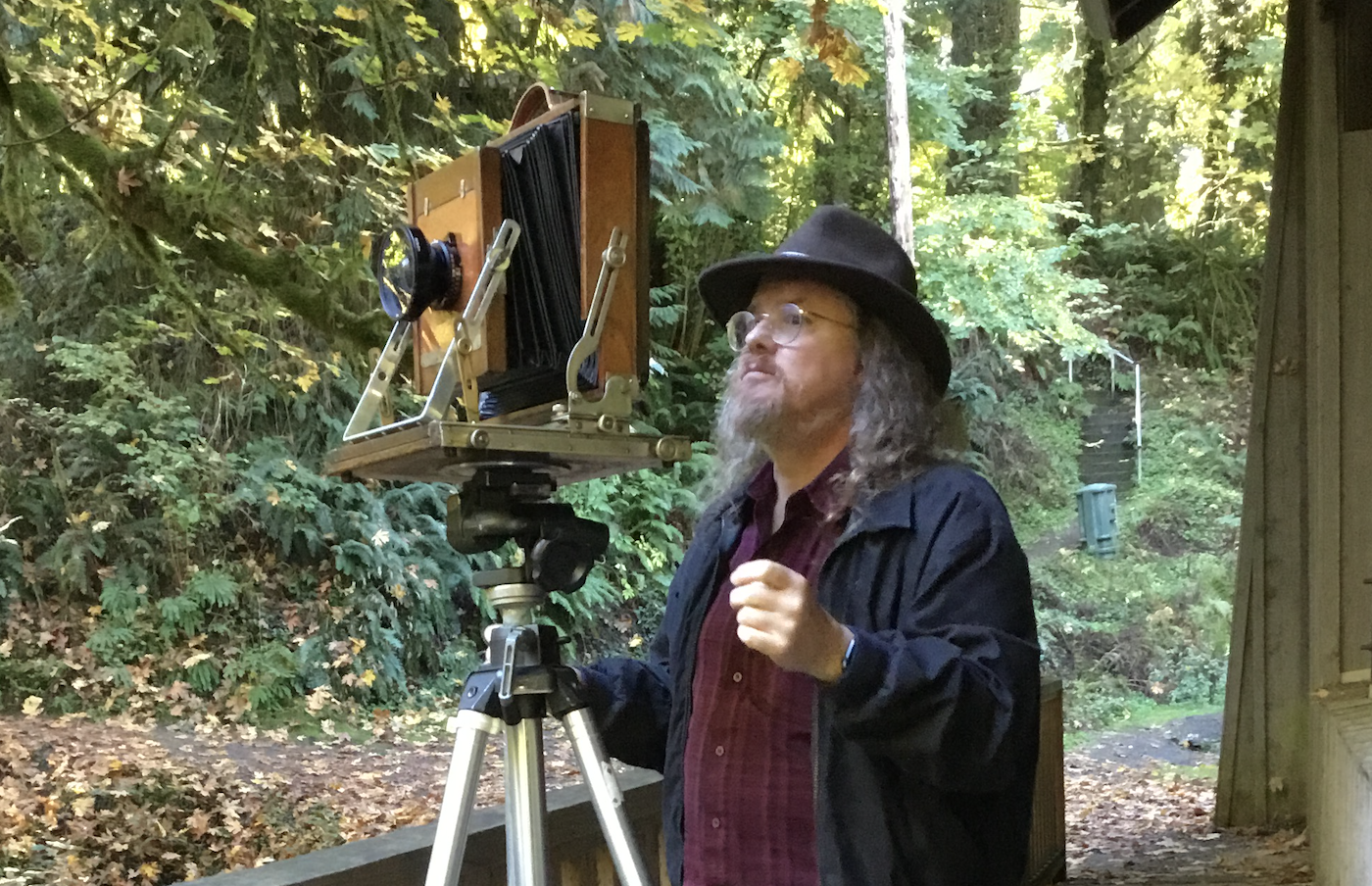
Me at the Cedar Creek Grist Mill in 2025.
My darkroom slogan was a take-off on a line from the movie “Apocalypse Now!”, “I love the smell of fixer in the morning.” (Fixer is the chemical that makes the image on the negative or paper permanent).
I even started to exhibit my work around the area.
The example of “Clearing Winter Storm” drove me to pursue the detail in an image, as well as the heroic landscape. While there has been a resurgence of film use in the last few years (of which I am immensely happy), I never left it behind. My eye was trained not by the Photoshop masters with extreme wide-angle lenses, but by the light that strikes the film negative, and the light that projects that image onto the black and white photographic paper. I learned the lights and darks of the world around me, and how to be there in the moment to experience them.
As is usual in life, things change. Illness in the family forced a move to Hood River, Oregon, that deprived me of my darkroom, and I reluctantly took up a digital camera in late 2015. My dreams of walking in Ansel Adams’ footprints had faded (although my first drafts of this book contained only film images). Since moving back to the Portland area in 2019, I built a new darkroom.
Hood River proved to be another turning point in my photography. I spent four years there, in the heart of the Columbia Gorge. It’s the place where the eastern Gorge meets the western Gorge. The weather patterns created by the Cascade Mountains cause an effect called the “rain shadow.” To the west of Hood River lies the rain-soaked, mossy cedars and waterfalls that make the place famous, and to the east is dusty, gravel roads, sagebrush, and breezy wheat fields. It was in those less-traveled, dusty places to the east where I found my photographic soul.
I once wrote a line of poetry for dry places, “Night falls as the desert wails of sandy dreams and dusty tales.” I could never quite figure out how to do anything with it. I had no concept of deserts, or even semi-arid landscapes when I wrote it when I was maybe 16. I think about it now and then when I travel in Oregon’s High Desert, or on the gravel roads I mentioned. I will never finish the poem, but the line is now in this blog (and maybe soon in a book). That counts for something.
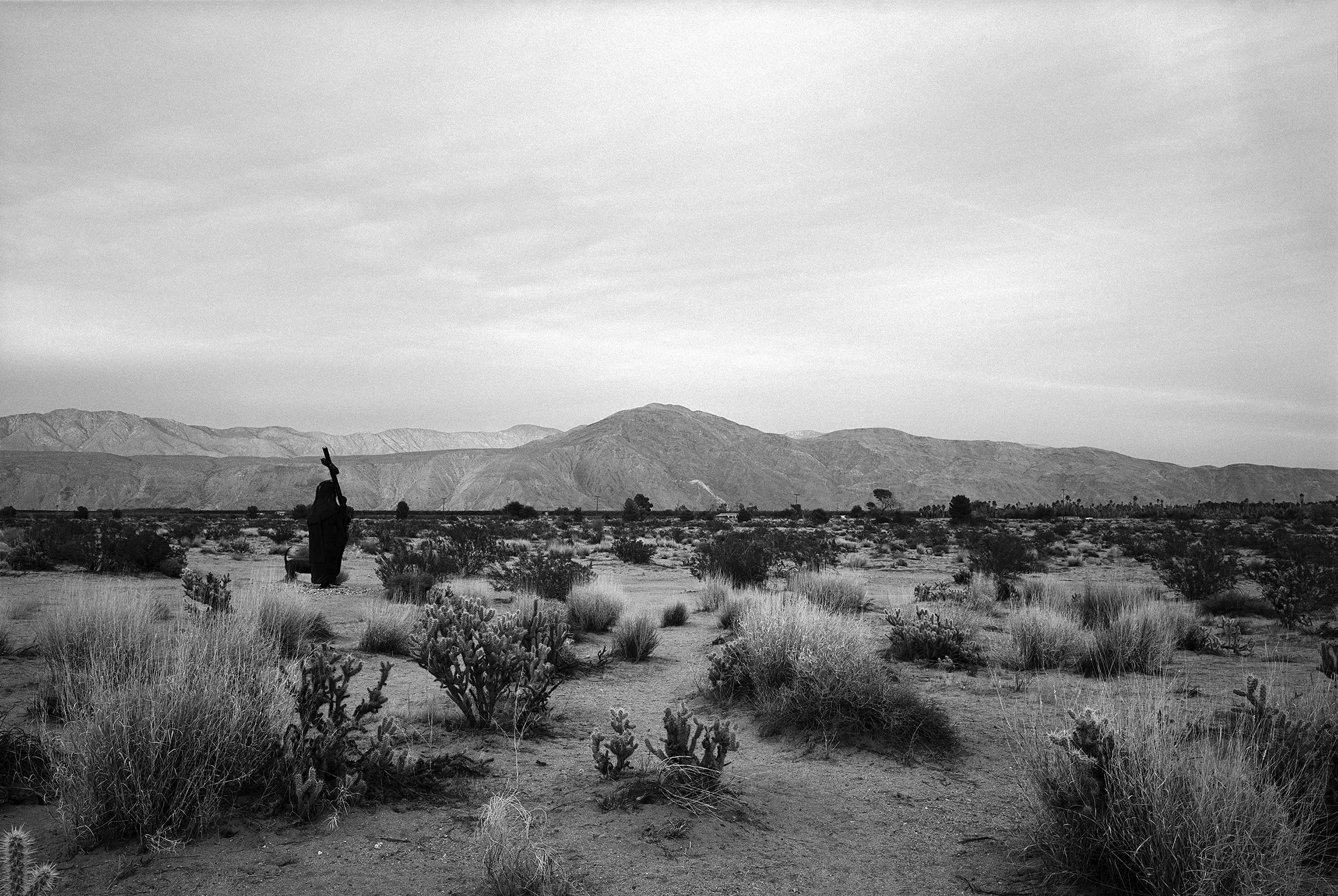
The Padre and The Coyote, Borrego Springs, California ©2023 Gary L. Quay
This is the first in a series of posts that I hope to compile into a book called “Stompin’ Grounds” in the near future.
You can see me these days at the Portland Saturday Market, or at art festivals around the area. I want my work to be featured in peoples’ homes where there is a kind of permenance, rather than on a computer screen where the changeing of technology will wipe it from the face of the Earth quicker than I would like. This blog will feature my travels, upcoming art festivals, and a smattering of darkroom technique. Please stick around. I promise to be thankful.
Gary L. Quay